Response to Climate Change
Sustainability
Response to Carbon Neutrality
The Company is advancing decarbonization initiatives across three scopes, Scopes 1, 2, and 3, with the goal of achieving carbon neutrality by 2050.
Scope 1: Optimization of the Number of Company Vehicles and Promotion of EV Adoption
Scope 1 covers direct emissions resulting from the use of company vehicles.
Under our management philosophy of contributing to the development of the automobile society and the improvement of the global environment, we are actively pursuing initiatives toward realizing a decarbonized society. As part of these efforts, we are promoting the reduction of our company vehicles by utilizing our own Vehicle Optimization Services. In addition, as a member of the automotive industry, we believe it is important to demonstrate leadership in reducing CO2 emissions. For this reason, we are accelerating the adoption of EVs for our company vehicles. In FY2024, 56.3% of our company vehicles were replaced with EVs. We aim to reach 61% by FY2025 and 100% EV adoption across all our vehicles by FY2030.
Scope 2: Transition to Electricity Derived from Renewable Energy Sources
Scope 2 covers indirect emissions associated with the use of electricity and heat at company offices.
Since all of our offices, including our head offices, are located in tenant buildings, it can be challenging to switch to electricity from renewable sources. Nevertheless, we are actively engaging with building owners to enable as many offices as possible to use renewable energy. In FY2024, our renewable energy adoption rate reached 55.8%, and CO2 emissions associated with electricity use were reduced by 11.6% compared with FY2023, thanks to the increased renewable energy adoption rate.
| 100% renewable energy | Partially renewable energy | |
|---|---|---|
| Sumitomo Mitsui Auto Service | Tokyo Head Office, Osaka Head Office, Minami-Tohoku Branch, Chiba Branch, Nagoya Branch, Toyama Branch, Kyoto Branch, Kobe Branch, Himeji Branch, Okayama Branch, Takamatsu Branch, Kumamoto Branch | Yokohama Branch |
| Ace Auto Lease | Kansai Branch | Head Office |
| Cedyna Auto Lease | Tokyo Head Office, Osaka Sales Department | ー |
| Mazda Auto Leasing | Shizuoka Branch, Osaka Sales Department | ー |
As of September 2025
Scope 3: Support Activities to Promote the Introduction and Widespread Use of EVs among Customers
Scope 3 covers indirect emissions from Categories 1, 2, 3, 5, 6, 7, and 13.
Although these emissions are not directly generated by SMAS, they account for a large portion of emissions across the entire supply chain. In particular, reducing GHG (greenhouse gas) emissions from Category 13 (downstream leased assets), is essential for achieving a decarbonized society.
To address this, SMAS provides customers with comprehensive support for EV adoption, including planning and peripheral services, through its EV One-Stop Service. This initiative actively promotes the adoption and widespread use of EVs in automobile leasing and contributes to CO2 reduction across the entire supply chain.
Supply Chain Emissions
In addition to calculating GHG emissions for Scopes 1 and 2, SMAS expanded its calculation boundary to include Scope 3 starting in FY2022. Initially, the data aggregation scope covered SMAS alone. For Scopes 1 and 2, the calculation boundary has since been expanded to include domestic affiliates and then overseas affiliates (excluding MaaS SHIFT Corporation., KD e-Solutions Company, Limited, and equity-method affiliates). Going forward, the Company plans to extend the Scope 3 calculation boundary to include affiliates as well.
Breakdown of Supply-Chain Emissions
Scope 1 and 2 emissions account for less than 0.1% of total supply chain emissions. Scope 3 emissions account for more than 99.9%.

Third-Party Verification of Supply Chain Emissions
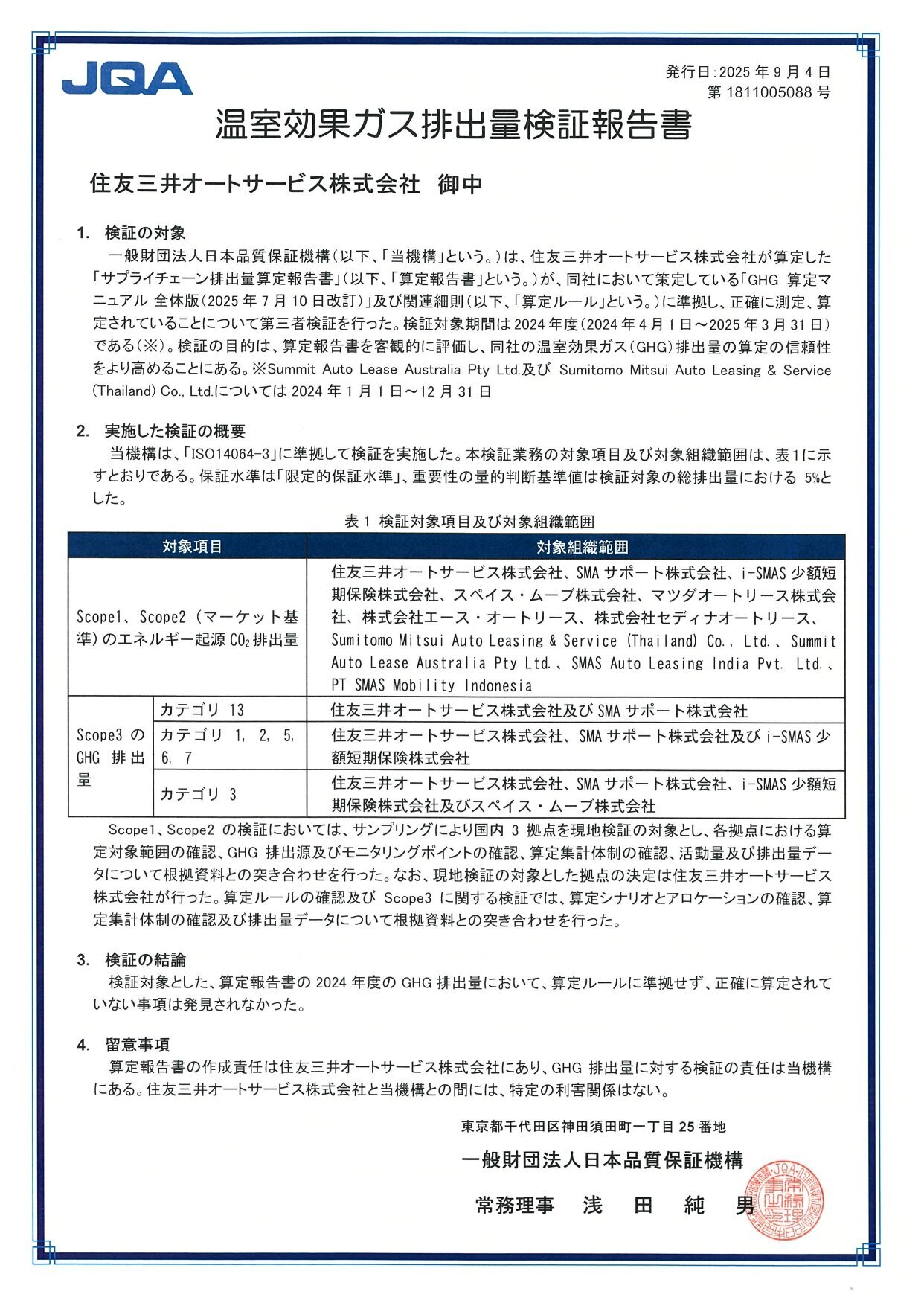
To enhance the reliability of its GHG emissions data, the Company undergoes third-party verification. For FY2024, SMAS obtained limited assurance covering Scope 1 and 2, as well as Scope 3 Categories 1, 2, 3, 5, 6, 7, and 13.
Response to Circular Economy
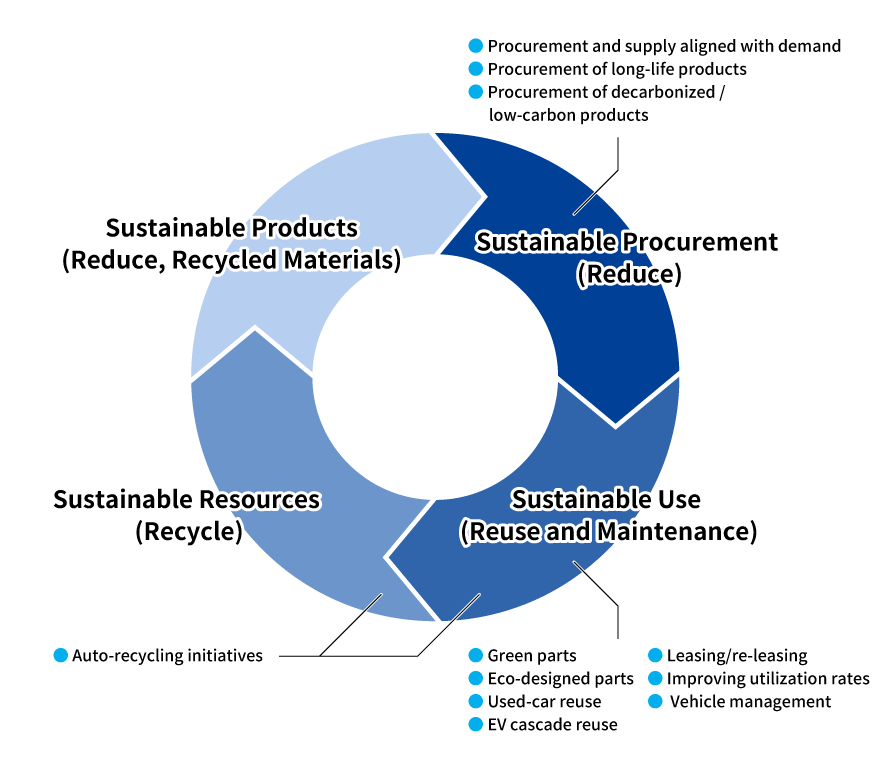
Our circular economy initiatives focus on sustainable procurement and support for customers' sustainable use of vehicles. At SMAS, more than 70,000 lease vehicles reach the end of their term each year, and many are reused as high-quality used cars. We also actively promote the use of green parts to reduce environmental impact during vehicle maintenance and parts replacement, while supporting sustainable vehicle operations.
Sustainable Procurement
We procure vehicles and parts based on actual demand, which means that in practice there is virtually zero loss. When providing vehicles, we actively procure high-quality, decarbonized or low-carbon vehicles with manufacturer warranties so that customers can use good products for a long time.
Support for Sustainable Use
Although SMAS's core business is auto leasing, we also offer vehicle-fleet optimization services that combine rentals, car sharing, and other mobility options. We provide vehicle-management services, including maintenance programs, to keep customer vehicles in good condition and to extend their service life. For parts replacement, we actively make use of green parts. For tire replacement, we use fuel-efficient, environmentally friendly tires or, depending on the region, all-season tires, or other parts with environmentally conscious design, thus contributing to reduced resource use and lower CO2 emissions.
Reusing End-of-Lease Vehicles as Used Cars
At SMAS, more than 70,000 lease vehicles reach the end of their term each year. We sell many of these as high-quality used cars, and also promote reuse within the SMAS Group, such as re-leasing vehicles or converting them for rental-car use. Since 2018, we have partnered with Nissan Motor Co., Ltd. and SUMITOMO CORPORATION on the EV Cascade Reuse Project, which promotes new second-life uses for EVs. Building on that experience, SMAS is accelerating its own initiatives in this area.
Expansion of the Auto-Recycling Business
Leveraging our extensive experience in reselling end-of-life vehicles in the reuse and recycling market, SMAS operates an auto-recycling business that intermediates the disposal of total-loss vehicles entrusted by insurance companies, leasing firms, rental-car operators, and others.
Proper Disposal Management
When disposing of vehicles, we verify whether dismantling contractors are properly certified and ensure that their manifest management follows legal requirements. This ensures that disposal is carried out appropriately and in compliance with relevant laws and regulations.
Alignment with TCFD (Task Force on Climate-related Financial Disclosure) Recommendations
We place strong emphasis on monitoring the impacts of climate change and strengthening our EV leasing business with a forward-looking perspective, given our role in supporting the automobile industry's transition to decarbonization. From a medium- to long-term viewpoint, we conducted analyses based on multiple scenarios, including the below 2°C scenario. Under both the 1.5°C and 4°C scenarios, climate-related risks to the Company are relatively limited. However, because the 1.5°C scenario presents a significant business opportunity for us, we are strengthening our strategies to expand the adoption of EV leasing as part of our decarbonization efforts.
Governance
The Sustainability Promotion Committee, chaired by General Manager of Head Office, reviews the Company's sustainability initiatives and reports to the Management Committee. Important matters concerning sustainability management, such as responses to climate change, are discussed in the Management Committee and subsequently reported to the Board of Directors. The Management Committee consists of the President and other executive officers.
Risk Management
SMAS identifies and evaluates risks and opportunities related to sustainability, including climate change, at an early stage, and determines its material (important) risks through the Sustainability Promotion Committee. These important risks are deliberated by the Management Committee and reported to the Board of Directors. Progress on key sustainability issues is properly managed through both the Sustainability Promotion Committee and the Management Committee.
Strategy
To pursue sustainability management that anticipates an uncertain future, we analyze multiple scenarios, including those limiting temperature rise to below 2°C, and formulate our climate strategies based on those results. Under both the 1.5°C and 4°C scenarios, climate-related risks are assessed as relatively limited and the overall impact on our business is considered moderate.
At the same time, based on a medium- to long-term evaluation of the 1.5°C scenario, we recognize that the transition to a decarbonized society will create significant opportunities for our business. Accordingly, we are strengthening our strategy to promote the introduction and widespread adoption of EV leasing as part of this transition.
| Scenario | Key issues | Classification | Impact on SMAS | |
|---|---|---|---|---|
| Short-term | Medium-/long-term | |||
| 1.5°C scenario | Climate change (carbon neutrality) | Risk | Small | Small |
| Opportunity | Small | Large | ||
| Resources circulation (circular economy) | Risk | Small | Small | |
| Opportunity | Small | Large | ||
| 4°C scenario | Natural disasters | Risk | Small | Small |
| Opportunity | Small | Small | ||
| Natural environment and biodiversity | Risk | Small | Small | |
| Opportunity | Small | Small | ||
Timeframe
For the climate-change scenario analysis, SMAS defines short-term as within 1 year, medium-term as up to 2030, and long-term as up to 2050.
Adopted Scenarios
1.5°C scenario is based on the Net Zero Emissions by 2050 Scenario (NZE) outlined in World Energy Outlook (WEO) 2021 issued by the International Energy Agency (IEA). 4°C scenario is based on the RCP8.5 Scenario outlined in the report by the Intergovernmental Panel on Climate Change (IPCC).
Details of risks and opportunities for each environmental issue are as follows.
Climate change (carbon neutrality)
| Classification | Details |
|---|---|
| Risks | SMAS does not own any assets that are at risk of becoming stranded, such as coal-fired power plants, nor does it operate factories. Because our business activities inherently generate very low environmental impact, we recognize that the transition toward a decarbonized society poses only limited risks for us. As for our products, namely leased vehicles, they are not expected to come under any severe regulatory restrictions. From the standpoint of climate change, the impact on the Company is therefore minimal, and we consider the likelihood of significant future impact to be low. |
| Opportunities | Companies are increasingly expected to address environmental and social issues, including climate change. As part of these efforts, more companies are now considering the introduction of EVs, and in the corporate-dominated automobile leasing market, EV demand is projected to continue rising. We view EV leasing as a central axis of business competitiveness and have set a medium- to long-term plan to increase the proportion of next-generation vehicles in our procurement portfolio. Our policy is to actively promote EV leasing. We have established a dedicated EV department to support EV adoption for customers and local communities. In addition to simply offering EV leases, we provide integrated proposals that include charging infrastructure, vehicle management and maintenance, thus accelerating the spread of EV usage. As demand for EVs is expected to grow even further, we anticipate that opportunities for our business will also expand accordingly in the future. |
Resource circulation (circular economy)
| Classification | Details |
|---|---|
| Risks | Because SMAS does not own maintenance workshops or similar facilities, the waste it generates consists primarily of general waste originating from its offices. In addition, when our products become lease-end vehicles, they are sold or disposed of through the used-car market. Accordingly, we believe that opportunities for us to generate vehicle-related waste directly are extremely limited. From the perspective of resources and waste, the impact on the Company is minimal, and we expect the likelihood of future impact to remain low. |
| Opportunities | When lease-end vehicles are not redeployed for a subsequent lease, SMAS sells them through used-vehicle channels such as auction houses. These activities contribute to circular resource use and extend the service life of vehicles. We also make effective use of resources by utilizing green parts in vehicle repair and related services. Given global resource depletion and population growth, demand for circular-economy initiatives is expected to increase further. We therefore anticipate that opportunities for SMAS's business to contribute in this area will continue to expand going forward. |
Natural disasters
| Classification | Details |
|---|---|
| Risks | Although certain natural disasters could potentially affect our borrowers or business sites, we expect the overall impact to be limited due to the geographic diversification of our portfolio and operations. From the perspective of natural disasters, the impact on SMAS is minimal, and we expect the likelihood of future impact to remain low. |
| Opportunities | Compared with sectors such as the non-life insurance industry, the automobile leasing industry has a relatively low degree of exposure to natural disasters. SMAS offers a vehicle disaster support program under which we conduct ad hoc, simplified inspections to determine whether existing customers' vehicles can continue to be used when they suffer water-related damage such as sub-floor (floor-level) inundation caused by heavy rain, flooding, typhoons, storm surges, or tsunamis triggered by earthquakes. In addition, we are working together with partner companies to advance related initiatives based on agreements with local governments on the introduction of EVs, procurement of renewable energy, and collaboration for disaster preparedness. However, given the relatively limited contribution of these activities to our business in the natural-disaster field, we expect the impact on the Company to remain modest going forward. |
Natural environment and biodiversity
| Classification | Details |
|---|---|
| Risks | As SMAS's operations have relatively limited interaction with the natural environment and biodiversity, especially compared with manufacturing and similar industries, we expect the impact on our business in these areas to remain modest in the future. |
| Opportunities | As SMAS's operations have relatively limited interaction with the natural environment and biodiversity, especially compared with manufacturing and similar industries, we expect opportunities for the Company's business to contribute in these areas to remain modest, with the scope of such contributions likely to stay limited in the future. |
This table was prepared by SMAS based on the evaluation items contained in the ESG Credit Outlook issued by Japan Credit Rating Agency, Ltd. (JCR).