Special Feature: Sustainability Dialogue
Sustainability

Looking Back on FY2024
Kageyama: SMAS is continuing to make steady progress as a Mobility Platform aiming for Sustainable Society. We were an early mover in the industry, having promoted the shift to EVs since 2009, and now we aim to accelerate our support for customers to adopt EVs as part of efforts toward carbon neutrality.
To lead by example, we set a goal of making 100% of our company vehicles EVs by FY2030. As of FY2024, we have already reached 56.3%, meaning that more than half of our company vehicles consists of zero-emission battery electric vehicles (BEVs).
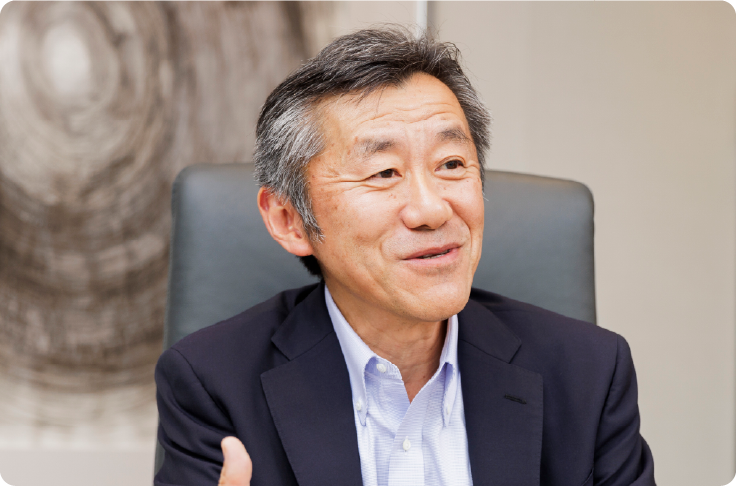
When advising customers considering BEV adoption, we openly and honestly share the insights, benefits, and challenges we have experienced ourselves. With over one million vehicles currently under lease and maintenance management to customers, we aim to drive carbon neutrality through popularizing EVs as leased vehicles.
Another key mission for SMAS is to eliminate serious traffic accidents among our customers. In addition to offering safe driving training, we provide our SMAS-Smart Connect telematics service. The onboard devices we installed in leased vehicles perform analyses such as creating near-miss maps for each driver and automatically distributing driving video feedback. This service, combined with driver coaching based on these digital records, contributes to reducing accidents.
In terms of promoting diversity internally, our percentage of female managers reached 9% in FY2024. While we recognize progress has been somewhat slow, we are steadily working toward our target for FY2027. For employee development, we are strengthening programs such as English training to support global business management. In FY2024, we also welcomed a French trainee from our partner company Arval in France, who shared insights on Arval’s sustainability and EV initiatives, providing valuable inspiration to our team.
Pedersen: SMAS is currently in a very interesting phase as it revamps its brand identity. What I particularly value is that the Company is not engaging in superficial sustainability, but rather pursuing genuine, fundamental initiatives. Globally, we are seeing a slight slowdown in EV adoption, yet SMAS continues to move forward steadily and consistently, which I find commendable. Because the promotion of EVs depends heavily on infrastructure development, it is essential to engage local governments and other stakeholders from multiple angles. It is clear to me that SMAS is actively working in this area.
At the same time, the organizational culture and human resource development that underpin mobility services will become increasingly important. Expanding business globally will be difficult unless SMAS embraces diverse perspectives to strengthen its competitiveness. I also look forward to seeing further progress in increasing the ratio of women in management positions.
Kageyama: In my ongoing conversations with Mr. Pedersen, I have learned that automobile leasing companies abroad place sustainability at the very core of their business models. The high ratings these companies receive from sustainability assessment organizations have inspired us to strengthen our own internal structure. We are also proactively engaging with local governments and have been taking various initiatives from the standpoint of a private-sector company. We have focused our approach to cover virtually all municipalities with populations under 300,000, as these tend to have faster decision-making, and this has resulted in a positive chain reaction where once one decides to adopt EVs, others are encouraged to follow suit. Going forward, we intend to further accelerate EV adoption through continued support for local governments.
Evolving Mobility and Emerging Trends
Kageyama: Alongside our engagement with local governments, we see collaboration among private-sector companies as becoming increasingly important. Given the rapidly changing external environment, marked by heightened uncertainty in energy policies and automotive regulations due to geopolitical risks, it is difficult for us to drive change on our own. We therefore plan to invest in companies that share our vision, such as those involved in the development and sale of charging infrastructure, and to work with them as partners in advancing EV adoption. The same applies to autonomous driving, which will certainly become more widespread in the years ahead. We intend to focus on finding partners with whom we can transform the future of mobility together.
As trends such as MaaS (Mobility as a Service) and CASE (Connected, Autonomous, Shared & Service, Electric) continue to evolve, SMAS will need to deliver new forms of value beyond the framework of traditional auto leasing. Engaging with the circular economy will also be essential. We are prioritizing both sustainable procurement and support for customers' sustainable use of vehicles, while also beginning to establish systems for reusing batteries and components domestically. As a mobility platform provider aiming for a sustainable world, SMAS will continue to endeavor to build a circular, vehicle-centered ecosystem.
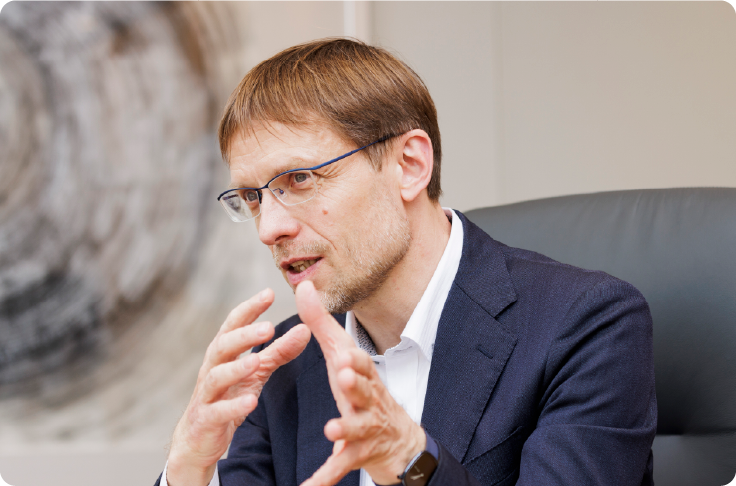
Pedersen: I personally use a car-leasing service myself, and I find it extremely convenient. In Japan, the automobile market continues to shrink amid population decline and has already reached a state of saturation. In this zero-sum situation, we need to shift the focus from owning to using a car and make leasing-based sharing economy the new standard. That, in my view, is essential from a sustainability perspective. I hope that SMAS will take the lead in driving this transformation.
Within SMAS, I also sense that the organizational mindset toward expansion abroad has begun to shift noticeably over the past year or two. In global markets, sustainability is simply a non-negotiable requirement. SMAS is actively exploring new models for achieving sustainable business growth, and I am very excited to see how those efforts develop.
Kageyama: You've gotten straight to the heart of the matter. To advance our sustainability initiatives, we intend to closely monitor global trends so that we can clearly identify what actions we need to take moving forward.
As a Sustainable Mobility Platform Provider
Kageyama: At a time when society is undergoing major transformation, the business opportunities for SMAS are virtually limitless. Compared with Europe and the United States, Japan still lags behind in sustainability, which means there is much more we can contribute. We are currently exploring ways to create a platform where companies can take collective action to promote sustainability, starting with the introduction of BEVs.
At the same time, labor shortages are a growing social issue in Japan, giving rise to greater expectations for autonomous driving technologies. For us, this also represents a significant business opportunity, and we intend to actively embrace such innovations. Ultimately, we want to become so closely associated with sustainability that people will say they "Think sustainability, think SMAS.”
Pedersen: Looking beyond Japan, there are still many regions in the Global South, including parts of Asia, where mobility services have yet to reach all communities. In those rapidly urbanizing megacities, the overpopulation of vehicles is becoming a major issue. If SMAS can propose sustainable mobility solutions that address these challenges and differentiate itself in doing so, new markets will open up. I look forward to seeing management that not only envisions the next world but also looks ahead to the world beyond that.
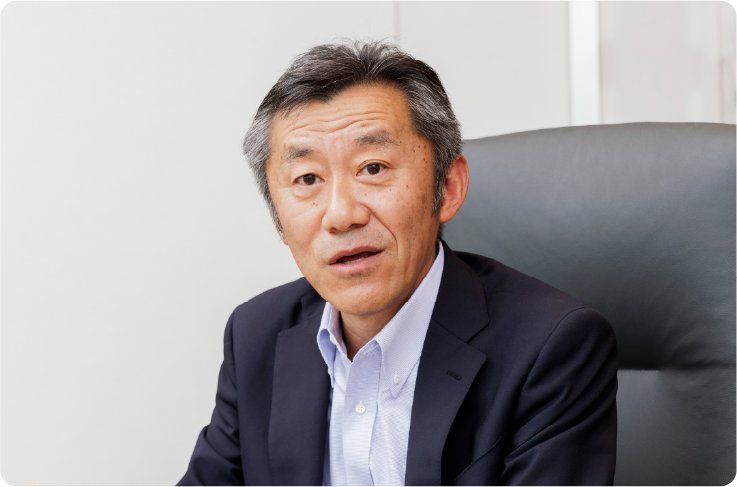
Kageyama: You are absolutely right—the increase in vehicle numbers is a global challenge. At SMAS, we are tackling this issue through initiatives such as our Mobility Passport app, which helps customers optimize the number of vehicles they operate. Some clients have even used the budget saved by reducing the number of vehicles to invest in charging infrastructure or the introduction of BEVs. We are engaging with customers in every possible way to help reduce CO2 emissions.
Pedersen: At the same time, the number of companies positioning themselves as sustainability-driven mobility platform providers is growing worldwide, and competition in this field is intense. As part of its global strategy, SMAS should continue to explore where it can establish a unique position among global competitors. At the very least, within Japan, I believe SMAS is well positioned to take the pole position as a platform provider that is economical, efficient, and environmentally responsible. To move forward even further, I hope the Company will also focus on transforming its culture toward organizations with cognitive diversity where a variety of perspectives can be voiced and psychological safety to allow those opinions to be truly heard.
Kageyama: Thank you very much. We are committed to continuing our efforts toward further growth and transformation.
Related Contents